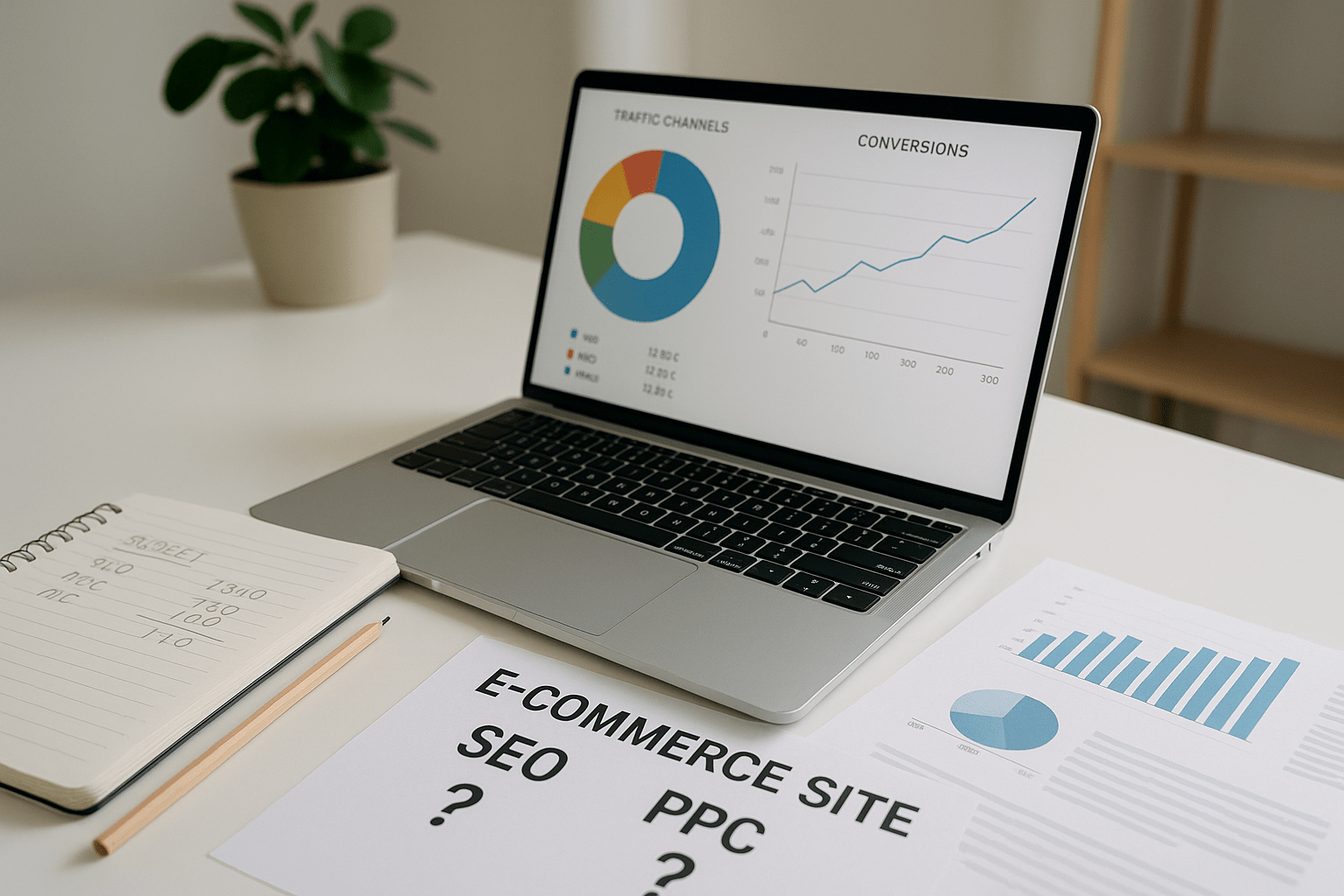
Short answer: most ecommerce sites need SEO and PPC running at the same time, because the two channels solve different problems. PPC buys immediate visibility and data, while SEO builds an asset that keeps earning after the invoice clears. The real question is not which one, it’s how much of your budget goes to each and when that ratio should change.
This is the part most articles skip. Below you’ll find the actual allocation math based on gross margin, average order value and inventory depth, plus how AI Overviews and LLM shopping assistants shifted the calculus going into 2026.
Why the “SEO or PPC” Question Is the Wrong Frame
Search behavior for shopping is split across two surfaces on the same page. Paid Shopping units, sponsored carousels and text ads occupy the top, while organic product and category listings, AI summaries and review content sit below.
If you fund only one, you’re visible for part of the query and invisible for the rest. According to the U.S. Census Bureau’s quarterly e-commerce report, online sales now account for roughly 16 percent of total retail spending, and the majority of that demand still starts with a search box.
A useful way to read the difference: PPC rents attention, SEO builds equity. Rented attention disappears the day you pause the campaign. Equity compounds, but it takes months to accrue.
What SEO Actually Does for an Ecommerce Store
Ecommerce SEO is less about blog posts than most owners expect. On a store with 400 products, the heavy lifting happens in the architecture: faceted navigation, canonical tags, internal linking between collections, and product schema that survives theme updates.
- Category and collection pages capture non-branded head terms like “waterproof hiking boots women” where commercial intent is high and click volume is deep.
- Product detail pages win long-tail model numbers and “brand + product” searches that convert at 3 to 6 percent instead of the sitewide 1.5 to 2.5 percent average.
- Comparison and buying-guide content earns links and gets pulled into AI answers, which is where mid-funnel research now lives.
- Technical health (crawl budget, index bloat from parameter URLs, Core Web Vitals) often unlocks traffic that no amount of content will fix on its own.
Platform choice matters more than people admit. We broke down whether store themes are SEO-friendly by default, and the honest answer is that most are adequate out of the box and mediocre at scale. Google’s own SEO starter guide covers the fundamentals worth auditing before you spend on anything advanced.
Timeline expectation: meaningful organic revenue lift typically shows up between month 4 and month 9 for a store with existing domain history, and closer to month 9 to 14 for a new domain in a competitive category.
What PPC Does That SEO Cannot
Paid search is the only channel where you can go from zero to first-page visibility in an afternoon. For a store launching a new product line, that speed is the whole point.
- Demand validation. Two weeks and $1,200 in Google Shopping spend will tell you whether a product has search demand at a price people will pay. No SEO test runs that fast.
- Query data. Search term reports show the exact language buyers use, which becomes your collection page targeting and title tag copy.
- Seasonal control. You can triple spend for Black Friday and cut it in January. Organic rankings don’t flex on command.
- Retargeting and retention. Cart abandoners, past purchasers and lookalike audiences are paid-only plays.
The risk is dependency. Stores that hit 80 percent of revenue from paid ads carry a fragile P&L: one CPC increase or account suspension and the month is gone. Whether you’re running paid advertising in Texas or managing accounts for a regional retailer through paid advertising in Delaware, the pattern holds: the healthiest accounts sit alongside a growing organic baseline.
How SEO and PPC Compound When Run Together
The overlap is where the return lives, and it’s mostly ignored in siloed setups. Four specific mechanics:
- Paid search terms become your keyword research. Converting queries from Shopping campaigns are proven buyer language, not estimated volume from a tool.
- Organic landing pages become better ad destinations. A category page with real content, reviews and fast load time lifts Quality Score, which lowers CPC.
- Dual presence increases total clicks. Owning an ad slot plus an organic listing for the same query usually raises combined click share rather than cannibalizing it, particularly on branded and high-intent terms.
- PPC covers the SEO ramp. During months 1 through 6 while rankings build, paid keeps revenue flowing so the SEO investment isn’t judged on an empty quarter.
Service businesses face a similar tradeoff, and our breakdown of local SEO vs Google Ads walks through the sequencing for lead-gen models.
The Allocation Math: Splitting Budget by Margin and AOV
Here’s the gap in most advice on this topic. The right SEO and PPC split isn’t a philosophy, it’s arithmetic driven by your gross margin and average order value.
Low margin, low AOV (under 30 percent margin, under $50 AOV)
Paid gets expensive fast because you can’t absorb a $4 CPC on a $38 order. Lean organic: roughly 65 to 75 percent of budget to SEO, with paid restricted to branded defense, Performance Max on best sellers and retargeting.
Healthy margin, mid AOV (40 to 60 percent margin, $75 to $250 AOV)
This is the balanced case. A 50/50 split works well, with paid targeting bottom-funnel product queries and SEO owning category and comparison terms.
High margin or high AOV (over 60 percent margin, or $400+ AOV)
You can afford aggressive customer acquisition. Push 60 to 70 percent to paid across Search, Shopping, YouTube and Meta, while SEO handles brand authority and long term cost reduction.
Narrow catalog under 25 SKUs
Limited page inventory caps organic upside, so weight paid heavier early and use SEO on educational content that supports the few products you sell.
Typical 2026 spend ranges for reference: ecommerce SEO retainers run $2,000 to $7,500 per month depending on catalog size and competition, management fees on paid sit at 10 to 20 percent of ad spend, and a credible Google Shopping test needs at least $1,500 to $3,000 per month in media to gather usable data. Most stores should plan on 8 to 12 percent of revenue going to marketing, higher during a growth push.
How AI Search Changed the Answer in 2026
AI Overviews and shopping assistants inside ChatGPT, Gemini and Perplexity now intercept a real slice of research queries. Buyers ask for a recommendation and get a synthesized answer with a handful of cited sources.
That shift cuts two ways. Informational traffic to thin blog content dropped, while being cited as a source became a new form of visibility that paid ads can’t buy directly. Structured product data, clear specs, honest comparison tables and third-party reviews are what get a brand pulled into those answers, which is the core of LLM optimization work.
Practically: your product feed quality now serves both channels. Clean titles, GTINs, attributes and accurate availability feed Merchant Center, organic Shopping surfaces and the AI models reading your pages. Fix the feed once and three channels improve.
When It’s Fine to Run Only One
There are legitimate single-channel cases, and pretending otherwise wastes money.
- Pre-product-market-fit: run paid only. Don’t invest 9 months of SEO into a catalog you may replace.
- Bootstrapped with under $1,500 per month total: pick one. Split budgets underperform both channels at that level.
- Restricted categories where ad policies block you: organic and email carry the load by necessity.
- Established brand with strong organic and thin margins: paid may only add cost, so audit incrementality before scaling it.
If you’re still deciding whether to hire help at all, our post on whether you need an SEO company to boost your business covers the in-house versus agency tradeoff for smaller teams. The same logic applies to niche service verticals: a specialized approach like pool company SEO looks different from a 5,000-SKU apparel store, and the budget split should reflect that.
Measuring the Two Channels Fairly
Judging SEO on last-click revenue and PPC on ROAS in isolation is how good programs get cancelled. Track a few numbers together:
- Blended CAC across all spend, reviewed monthly against contribution margin.
- Non-branded organic revenue separated from branded, so paid-driven brand lift isn’t credited to SEO by accident.
- Assisted conversions to see where organic content touches paid conversions earlier in the path.
- Share of voice on your top 50 commercial queries, paid plus organic plus AI citations.
Review at 90-day intervals. Paid can be judged in 30 days; organic needs at least two quarters before the trendline means anything.
Frequently Asked Questions
Which one is better, SEO or PPC?
Neither is universally better: PPC delivers traffic within 24 hours but stops when spending stops, while SEO typically takes 4 to 9 months to produce meaningful revenue and then keeps producing at a declining marginal cost. For ecommerce specifically, paid usually wins on speed and testing, and organic wins on long term profit per order.
What is the 80/20 rule in ecommerce?
The 80/20 rule holds that roughly 80 percent of revenue comes from about 20 percent of products or customers. In practice it means you should concentrate ad spend and SEO effort on that top 20 percent of SKUs first, then decide whether the long tail earns any budget at all.
Is SEO worth it for ecommerce?
Yes for most stores with more than 25 products and a plan to operate beyond 12 months, since organic traffic carries no per-click cost and often converts as well as paid on branded and long-tail queries. It’s a poor fit for stores still testing products or brands that cannot commit at least two quarters of consistent work.
What are the 5 C’s of ecommerce?
The 5 C’s are commonly listed as company, customers, competitors, collaborators and context, borrowed from the classic marketing framework. Some retail versions swap in convenience, choice, cost, communication and customization, and either set is useful as a checklist before you allocate a marketing dollar.
How much should an ecommerce store spend on SEO and PPC combined?
Most growing stores allocate 8 to 12 percent of gross revenue to marketing, with SEO and PPC typically taking 50 to 70 percent of that. A store doing $80,000 per month would commonly run $3,000 to $5,000 in paid media plus a $2,500 to $4,000 SEO engagement.
Want a Straight Answer on Your Split?
Send us your margins, AOV and current channel mix, and we’ll show you where the next dollar returns the most. SEO Locale builds ecommerce programs that treat search and paid as one system instead of two invoices.