Roofing companies operate in one of the most competitive service industries in the United States, where understanding how SEO helps roofing companies win more local leads is essential for long-term growth. Relying solely on word-of-mouth or expensive pay-per-click advertising often yields inconsistent results for growing businesses. Search Engine Optimization (SEO) offers a sustainable alternative by positioning your company directly in front of homeowners exactly when they need help. A strategic approach to search rankings transforms your website from a digital brochure into a primary revenue driver for your roofing business.
Most homeowners turn immediately to Google when they notice a leak or need a full roof replacement. Data indicates that the top three results in local search capture the vast majority of these high-intent clicks. If your business does not appear in this prime digital real estate, you effectively hand those leads to your competitors. SEO helps roofing companies win more local leads by aligning your online presence with the specific signals search engines use to recommend professional roofing contractors.
This process involves more than just inserting keywords into your website text; it requires a systematic improvement of your entire digital footprint. By addressing specific ranking factors, you build trust with both search algorithms and potential customers. The following analysis outlines exactly how these mechanisms work and how you can leverage a comprehensive roofing SEO strategy to dominate your local market.
Table of Contents
- Local Search Rankings: How SEO Helps Roofing Companies Win More Local Leads
- Google Business Profile Optimization for Roofing Lead Generation
- Roofing Keywords: Keyword Research for High-Intent Leads
- On-Page SEO Signals: Optimizing Your Roofing Website for Conversions
- Technical SEO: Building a High-Performance Roofing Website Foundation
- Local SEO for Roofers: The Role of Reviews and Reputation
- Tracking ROI: Measuring Success in Search Engine Optimization for Roofing
Local Search Rankings: How SEO Helps Roofing Companies Win More Local Leads
Google uses a distinct algorithm for local service searches compared to general informational queries. When a user searches for “roof repair,” the search engine prioritizes results based on relevance, distance, and prominence. Understanding these three pillars allows you to adjust your roofing SEO strategy to meet the specific criteria Google values most. Relevance refers to how well your business profile matches the user’s specific problem or need.
Distance is a factor that you cannot change, as it relies on the user’s physical location relative to your office. However, you can influence how Google perceives your service area through proper optimizations. Prominence is where your marketing efforts have the biggest impact, as it measures how well-known and trusted your business is online. Building prominence requires a combination of high-quality links, articles, and directory listings to boost your organic traffic.
The “Local Pack” or “Map Pack” is the block of three business listings that appears at the very top of search results. Securing a spot here is the primary objective for any local SEO campaign because it generates the highest volume of phone calls. These listings display your reviews, address, and phone number instantly, allowing customers to contact you without even visiting your website. Improving your standing in these three areas directly correlates with an increase in monthly inquiries and search engine rankings.
Google Business Profile Optimization for Roofing Lead Generation
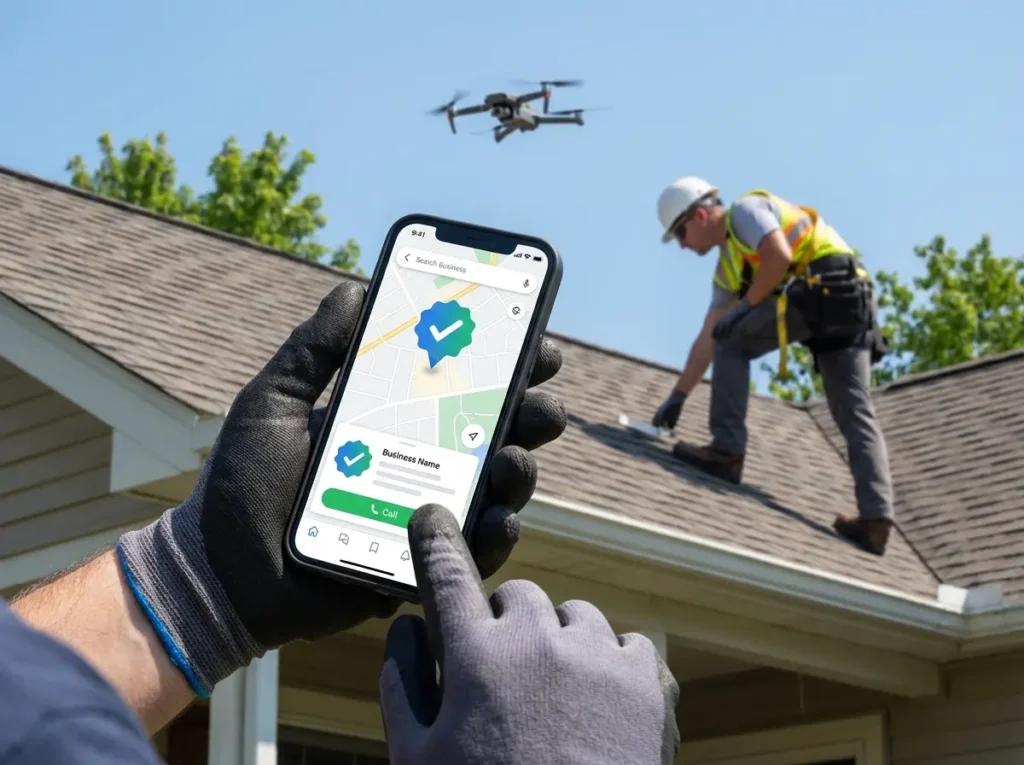
Your Google Business Profile (GBP) serves as your most valuable asset for capturing local leads. It acts as a secondary homepage that lives directly on Google’s servers, providing immediate information to prospects. Many roofing companies claim their profile but fail to fill out every available field, which limits their visibility. A fully executed Google Business Profile optimization signals to Google that your business is active, legitimate, and ready to serve customers.
You must verify that your primary category is accurately set to “Roofing Contractor.” Secondary categories should include specific services you offer, such as “Gutter Cleaning Service” or “Siding Contractor,” if applicable. This helps you appear in searches for those specific terms, expanding your potential client base. Consistency in your business name, address, and phone number (NAP) across the web reinforces the validity of your GBP data and improves local search visibility.
Photos play a surprisingly large role in how users interact with your listing. Uploading high-quality images of completed projects, your team, and your branded trucks builds immediate credibility. Regular updates through Google Posts keep your profile fresh and allow you to highlight seasonal offers or recent storm damage advice. Active management of this profile is a non-negotiable requirement for staying competitive in local search results and roofing lead generation.
Quick Summary:
- Complete every field in your Google Business Profile to maximize visibility.
- Select the correct primary and secondary categories to capture relevant traffic.
- Upload authentic photos of your team and projects to build trust.
Roofing Keywords: Keyword Research for High-Intent Leads
Successful SEO campaigns focus on roofing keywords that demonstrate a clear intent to purchase services. A user searching for “how to fix a shingle” is likely looking for a DIY tutorial, whereas someone searching for “emergency roof repair Philadelphia” needs professional help immediately. Identifying and targeting these high-intent phrases prevents you from wasting resources on traffic that will never convert into paying jobs. You want to attract visitors who have their credit cards ready.
You should organize your keyword strategy into different service buckets, such as residential replacement, commercial roofing, and storm damage repair. Each of these categories requires distinct pages on your website to address the specific needs of that customer base. Search engines look for topical authority, meaning they want to see that you are an expert in all facets of roofing. Creating detailed content around these specific terms helps Google understand exactly what you do and improves your search engine optimization for roofing.
Long-tail keywords are particularly effective for local businesses because they often have lower competition and higher conversion rates. Phrases like “metal roof installation for commercial buildings” may get fewer searches than “roofing,” but the traffic is far more valuable. Incorporating location modifiers—such as your city, county, or neighborhood names—into these keywords further refines your audience. This strategy filters out irrelevant visitors from outside your service area and targets competitive keywords effectively.
On-Page SEO Signals: Optimizing Your Roofing Website for Conversions
Your website structure must communicate clearly with search engine crawlers while simultaneously persuading human visitors to take action. Each service page should feature a clear hierarchy of headings that include your target keywords naturally. The content needs to address common pain points, such as pricing transparency, warranty information, and timeline expectations. When you answer these questions directly on the page, you reduce friction and improve conversion rate optimization.
Location pages are a powerful tool for roofing companies that serve multiple towns or counties. You should create a dedicated page for each major city you serve, featuring specific projects you have completed in that area. This approach signals to Google that you are active in those specific communities, increasing your chances of ranking in the Local Pack for those towns. However, you must avoid simply duplicating the same text across every page to maintain a high-quality user experience.
Warning: Avoid copying and pasting the same content across multiple location pages. Google may filter these out as duplicate content, which hurts your ability to rank.
Internal linking is another critical on-page signal that guides users and search bots through your site. You should link from your blog posts about storm damage to your emergency repair service page. This transfers authority from your informational content to your money-making pages. A logical link structure helps Google index your site more effectively and keeps users engaged longer, which is a core component of digital marketing for roofers.
Technical SEO: Building a High-Performance Roofing Website Foundation
Even the best content will fail to rank if the underlying website structure is flawed or slow. Technical SEO involves optimizing the backend elements of your site to meet modern performance standards. Site speed is a massive factor, especially since most homeowners will search for your services on a mobile device. If your site takes more than three seconds to load, users will likely bounce back to the search results, negatively impacting your core web vitals.
Mobile responsiveness is non-negotiable in the roofing industry, where emergencies often dictate immediate searches from smartphones. Your website must adjust seamlessly to different screen sizes, ensuring that buttons are clickable and text is readable without zooming. Google uses mobile-first indexing, meaning it looks at the mobile version of your site to determine your ranking. A poor mobile experience directly penalizes your visibility and roofing lead generation efforts.
Schema markup is a piece of code that helps search engines understand the context of your content. For roofers, LocalBusiness schema can tell Google your operating hours, service area, and accepted payment methods. Implementing this code can enhance your search listings with rich snippets, making your result stand out visually. This technical detail often separates elite-level SEO campaigns from basic implementations on a roofing website.
Local SEO for Roofers: The Role of Reviews and Reputation
Online reviews are one of the strongest signals of prominence and trust for local businesses. Effective local SEO for roofers relies on a steady stream of positive feedback to validate your services to search engines. Quantity, quality, and recency all factor into how much weight these reviews carry in your ranking calculation. A profile with fifty 5-star reviews from three years ago is less valuable than one with regular reviews coming in every week.
You must implement a system for requesting reviews from every satisfied customer immediately after job completion. This can be as simple as an automated email or text message containing a direct link to your Google profile. Responding to every review—positive or negative—demonstrates that you are engaged and care about online reputation management. This activity signals to Google that the business is active and responsive.
Handling negative reviews professionally can actually improve your conversion rate by showing you stand behind your work. Future customers read these responses to see how you resolve conflicts when things go wrong. A calm, solution-oriented reply mitigates the damage of a bad rating. Ignoring negative feedback leaves a permanent stain on your digital reputation that competitors can exploit in the local search rankings.
Tracking ROI: Measuring Success in Search Engine Optimization for Roofing
The ultimate goal of search engine optimization for roofing is revenue generation, not just vanity metrics like traffic or clicks. You need to know exactly how many leads your organic search efforts are producing each month. Tracking allows you to calculate your return on investment and make data-backed decisions about your marketing budget. Without this data, you are essentially flying blind in your conversion tracking efforts.
Call tracking software is essential for attributing phone leads to specific marketing channels. By using dynamic number insertion, you can see which users called you after finding your site through Google organic search. Form tracking is equally important for capturing leads that prefer to request a quote online. These two metrics combined give you a clear picture of your campaign’s effectiveness and overall roofing lead generation success.
Setting up this infrastructure requires some technical configuration, but the insights are invaluable. You can identify which pages generate the most leads and which ones need improvement. This data enables you to refine your strategy continuously, doubling down on what works. The following steps outline how to establish a basic tracking setup for your roofing SEO strategy.
How to Set Up Basic Lead Tracking
- Identify Your Conversion Goals: Determine exactly what counts as a lead for your business, such as a contact form submission or a phone call over 60 seconds. Tip: Don’t track page views as conversions; focus only on actions that lead to revenue.
- Install Google Analytics 4 (GA4): Create a GA4 account and add the tracking code to the header section of your website to begin collecting user data. Tip: Use Google Tag Manager to make future code updates easier without needing a developer.
- Configure Conversion Events: Mark specific events, like the “Thank You” page view or a click on your phone number, as conversions within the GA4 settings.
Conclusion
Investing in SEO provides roofing companies with a durable asset that appreciates over time. Unlike paid ads that stop generating leads the moment you pause your budget, a strong organic presence continues to deliver value for years. By building a foundation of technical excellence, creating content that answers customer questions, and managing your local reputation, you secure a steady pipeline of work. This stability allows you to plan for growth rather than worrying about where the next job will come from.
The market for roofing services in the United States will always be competitive, but high-ranking positions are available for those who put in the work. You do not need to outspend the largest national chains; you simply need to outwork them in your specific local area. Focus on the fundamentals of relevance, prominence, and trust to separate your business from the noise. Start optimizing today, and you will see the difference in your bottom line through effective local SEO for roofers.
Quick Summary:
- SEO offers a long-term, sustainable lead source unlike temporary paid advertising.
- Tracking specific conversion metrics is essential for measuring true ROI.
- Consistent effort in reviews and content builds a defendable market position.