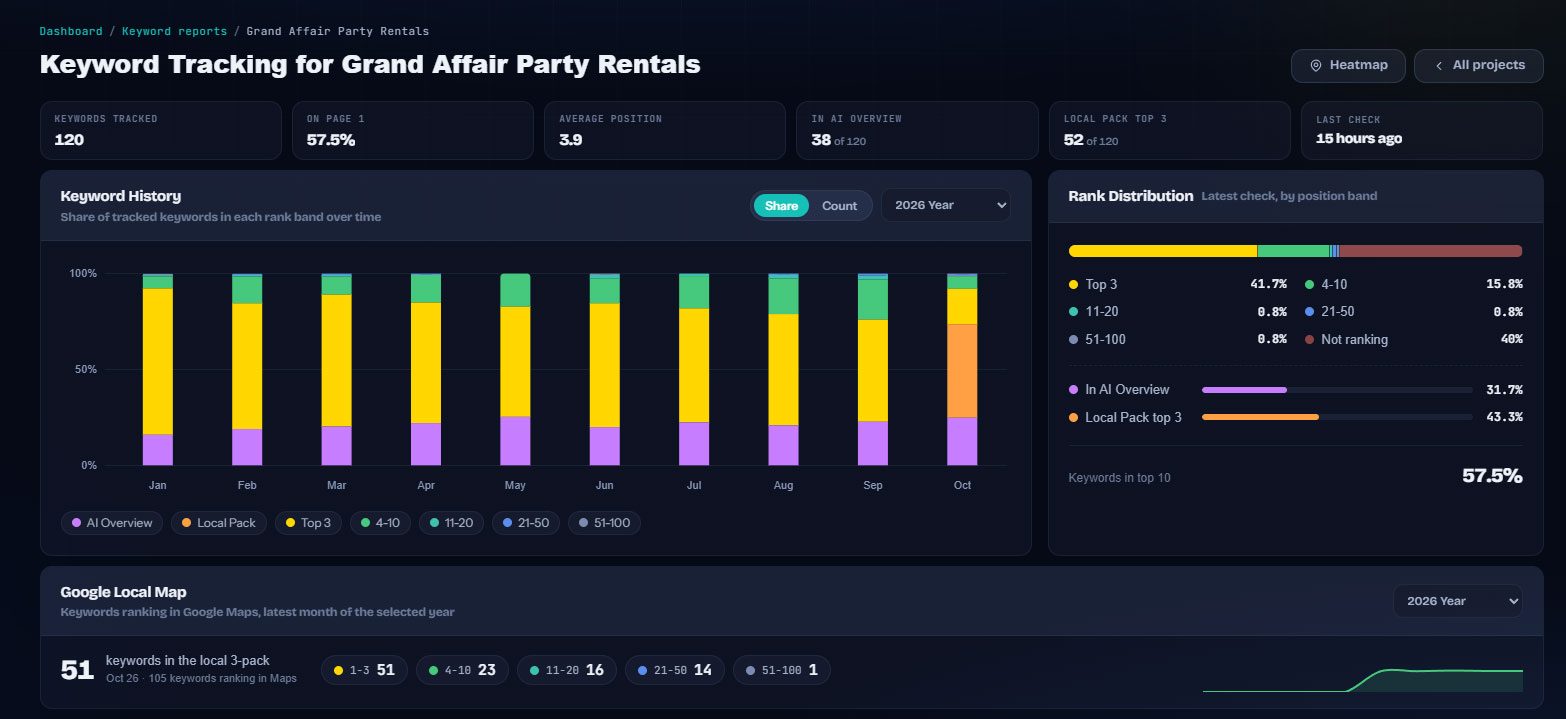

Our rank tracker checks every keyword we track for every client each week, and the clearest lesson from that data is that local rankings move constantly, while the businesses that keep doing the basics keep most of their page-one positions through the swings. This post shows the latest figures straight from the tracker, explains how to read them, and covers what a business owner should and should not take from rank data.
Key takeaways
- Every figure in this post is pulled live from SEOApp, the rank tracker we built, so it updates as the data does.
- Page one and the top three are different goals. The map pack and the first few organic results take most of the clicks.
- Positions swing week to week for reasons that have nothing to do with your business. Trends over months matter more than any single check.
- The number of tracked keywords changes too, as keywords are added or removed and as clients join or leave, so totals should always be read alongside that count.
- The map pack and the organic results are ranked differently, and a local business usually needs to win both.
Where these numbers come from
SEOApp is the rank tracking tool we built and use for every client. Each week it checks where each client’s website ranks on Google for each keyword in their plan, and records the position alongside the position from the previous check. The figures below are not a sample or a survey. They are the latest totals across every keyword we track, and they refresh automatically each time the tracker runs.
Two rules apply to everything that follows. First, we never show client names or the places in their keywords; the server blanks anything that could identify a client before it reaches this page. Second, we do not edit the numbers. If a week is flat or down, it shows flat or down. You can see the same data, every client ranking we track, on our Scoreboard.
The latest figures from the tracker
The table below shows the most recent weekly checks: how many tracked keywords were on page one, how many climbed, and the positions gained. Where there is enough history, it also shows the biggest single climbs at the latest check, with places and client details blanked.
Figures from SEOApp, the rank tracker we built, covering every keyword on every client site we track. Pulled weekly; this table runs Oct 28, 2026 to Nov 5, 2026.
| Checked | On page 1 | Climbed that week | Positions gained |
|---|---|---|---|
| Nov 5, 2026 | 7,175 | 2,058 | +93,608 |
| Nov 5, 2026 | 7,077 | 2,034 | +92,541 |
| Nov 5, 2026 | 7,171 | 2,048 | +93,205 |
| Nov 4, 2026 | 7,011 | 753 | +35,806 |
| Nov 3, 2026 | 5,827 | 867 | +56,813 |
| Nov 3, 2026 | 5,827 | 867 | +56,813 |
| Nov 3, 2026 | 5,827 | 867 | +56,813 |
| Oct 30, 2026 | 6,112 | 2,067 | +102,111 |
| Oct 30, 2026 | 6,112 | 2,067 | +102,111 |
| Oct 30, 2026 | 6,112 | 2,067 | +102,111 |
| Oct 28, 2026 | 5,854 | 1,804 | +82,447 |
| Oct 28, 2026 | 5,854 | 1,804 | +82,447 |
| Oct 28, 2026 | 5,854 | 1,804 | +82,447 |
The biggest climbs at the latest check. The place and anything that could name the client are blanked by the server.
- air conditioning #99 → #1
- medical #94 → #5
- hearing loss #93 → #5
- shipping containers #90 → #3
- title insurance #86 → #1
- ocean city #90 → #8
- civil litigation #81 → #1
- sinus surgery #81 → #1
- rental properties #86 → #9
- mig welding #77 → #1
If the table above is empty, the tracker has not yet built enough weekly history to show a trend. It fills in as each weekly check runs.
How to read rank data
Page one versus the top three
“Page one” means positions one to ten. It is a useful milestone, but the clicks are not spread evenly across it. For a local search, the map pack and the first few organic results usually get most of the attention, and on a phone the lower half of page one can be several screens down. That is why we report both: page one shows a keyword is in contention, and the top three shows it is likely to be producing calls.
A keyword moving from position nine to position four is often worth more to a business than a keyword moving from position forty to position twelve, even though the second move is bigger. Read the movements in light of where they end up.
Why positions swing week to week
If you check your own rankings often, you will see them move, sometimes by several places, without anything changing on your site. That is normal. A few of the reasons:
- Google updates. Google adjusts its ranking systems constantly, with larger updates several times a year. Each one reshuffles results across many industries at once.
- Competitors. A competitor publishes new pages, earns reviews, fixes their site, or starts running a bigger campaign.
- Personalization and location. Local results depend on where the searcher is. A check from one point in a town can differ from a check a mile away.
- Result layout changes. When Google adds an AI Overview, a map pack, videos or “People also ask” to a results page, organic positions shift even if the order of websites does not. Google explains how its AI features relate to websites.
Because of this, we judge progress by the trend across several weeks, not by any single check. A keyword that drops two places one week and recovers the next has not really moved.
Why the number of tracked keywords changes
Totals like “keywords on page one” depend on how many keywords are being tracked. That number changes for reasons that have nothing to do with performance:
- Keywords are added. When a client adds a new service or town, we add the keywords for it. New keywords usually start low and climb, which can make the average look worse for a while even as the business grows.
- Keywords are removed. A client may drop a service, or a keyword may turn out to be irrelevant, and we stop tracking it.
- Clients join and leave. When a new client starts, their keywords enter the tracker, often far from page one. When a client stops, their keywords leave it.
This is why the Scoreboard explains dips rather than hiding them. A fall in page-one keywords alongside a fall in tracked keywords usually means keywords left the tracker. A fall with the tracked count steady means rankings actually moved.
The map pack and organic results are different races
Local searches usually show two kinds of results: the map pack with three businesses, and the organic results below it. They are ranked differently.
| Map pack | Organic results | |
|---|---|---|
| What ranks | The Google Business Profile | The website’s pages |
| Biggest factors | Distance from the searcher, relevance of the profile, prominence including reviews | Relevance of the page, quality of content, links, technical health |
| Reach | Mostly near the business address | Can reach further, with a page for each area |
| Main work | Profile optimization and reviews | Pages, content, links and technical SEO |
A business that wins the map pack in its own town can still be invisible in the next town over, which is why a plan for several areas needs pages for each, not just a profile. Google describes the map pack factors in its guidelines for representing your business and related help pages.
Seasonality
Search demand moves with the seasons, and rankings can move with it as competitors push harder at peak times. Heating companies see winter spikes, landscapers see spring, accountants see tax season, and tourism-driven businesses see summer. A drop in calls during an off-season is not always a drop in rankings, and a ranking gain in an off-season may not show in calls until demand returns.
Figures by industry
The tracker also sorts keywords by the trade they are about. Where there are enough client keywords on page one for a trade, its figures appear below. Where there are not, the band does not show, rather than showing a number too small to mean much.
For home services, including plumbing, HVAC, roofing and the other trades, the latest figures from the tracker are below where there is enough data.
- kitchen remodeling #1
- plumber #1
- concrete contractors #1
- commercial landscaping #1

Real positions from SEOApp, the rank tracker we built, checked Nov 5, 2026. Places and anything that could name a client are blanked. See the Scoreboard.
For law firms, the same view of the tracker’s data appears below where there is enough data to show.
- medicaid attorney #1
Real positions from SEOApp, the rank tracker we built, checked Nov 5, 2026. Places and anything that could name a client are blanked. See the Scoreboard.
And for healthcare practices, including medical, dental and therapy clinics, the figures appear below when the tracker has enough of them.
- medical #1
- family dentist #1
- emergency dentist #1
- family dentistry #1
Real positions from SEOApp, the rank tracker we built, checked Nov 5, 2026. Places and anything that could name a client are blanked. See the Scoreboard.
The same kind of band appears on many of our industry pages and town pages, showing the tracker’s figures for that page’s trade or place.
What rank data does not show
Rank tracking is useful, but it has limits worth knowing before you read too much into it.
- It is a snapshot from one place. A tracker checks from a set location and device. Real searchers are spread across a town, on phones and computers, and some of them see slightly different results.
- It does not count clicks or calls. A ranking says where a page appeared, not how many people chose it. That comes from Search Console, call tracking and the Google Business Profile.
- It cannot see every search. People phrase the same need many ways. A plan tracks the important phrases, but customers also arrive from searches no one thought to track.
- It does not show AI answers in full. Being named in an AI Overview or a chatbot answer is a separate kind of visibility, and it needs its own checks.
That is why our reports put rankings next to calls, forms and profile actions. Together they show whether the work is reaching customers.
What a business owner should take from rank data
- Track the right keywords. The keywords worth tracking are the ones your customers type when they are ready to buy, for each service and area you serve. Vanity keywords that nobody searches make a report look good and do nothing.
- Look at trends, not single checks. Judge the direction over a month or a quarter.
- Read rankings next to calls. Rankings are a leading indicator. Calls and forms are the result. If rankings rise and calls do not, look at the page, the profile and the phone handling.
- Expect new keywords to start low. Adding a service or town will lower averages for a while. That is growth, not decline.
- Keep doing the basics. The businesses that hold their positions through Google’s updates are the ones that keep their profile active, keep earning reviews and keep their pages accurate and useful. Google’s guidance on helpful, people-first content is the best summary of what lasts.
How we use this data for clients
Every client’s keywords are tracked weekly in SEOApp from the day they start. The monthly report shows where each keyword ranks, how it moved, and what we did that month, alongside the calls and forms from organic search. When a keyword drops, we look at why: an update, a competitor, a change on the results page, or something on the site. When a group of keywords is stuck, that is where the next month’s work goes.
The same data shapes the plan for a new client. Before we start, the free audit shows where a business ranks today for its services and areas, who sits above it, and what it would take to move. Our process and reporting page shows what the reports look like, and our local SEO service explains the work behind the numbers.
Frequently asked questions
What is SEOApp?
SEOApp is the rank tracking tool SEO Locale built and uses for every client. It checks each tracked keyword on Google every week and records the position and the change since the last check.
Are these numbers updated?
Yes. The figures in this post are pulled live from the tracker and refresh each time it runs. Nothing is typed in by hand.
Why do my rankings go up and down every week?
Google updates, competitor activity, the searcher’s location and changes to the layout of the results page all move positions. Judge progress by the trend over several weeks rather than any single check.
Is page one good enough?
It is a useful milestone, but the map pack and the first few organic results take most of the clicks for local searches. Aim for the top three on the terms that bring customers.
Why are client names hidden?
A client’s keywords are part of their strategy. The tracker blanks client names, places and anything else that could identify a business before the data appears on our site.
Can I see where my business ranks?
Yes. Our free audit shows where you rank for your main services and areas, who is above you and what it would take to change that.